Your NIH Phase II data system for 2.8% of the award.
Kubyk is the data system for your SBIR or STTR study, already built and hosted. It collects data from your connected device or health app and gives investigators and participants their own portals. Scale, our plan for Phase II, is $2,500 a month with no contract to negotiate.
Each percentage is the Kubyk cost divided by the NIH award shown. Phase I and Phase II amounts are NIH's standard limits; many institutes allow more on approved topics. Lab+ is for building and testing, Scale for studies with real participants, and Enterprise for patients in care and programs going to FDA.
Build your Phase I on the platform you will keep.Ready for your first participant.A data system your regulatory strategy can stand on.A data system your regulatory plan can stand on.
Scale comes with what a study with real participants needs: device connections, portals for each site, missing-data reminders and a full audit trail. You set it up for your study, and we host and run it.
Lab+ ($500 a month) lets you build and test your whole system on synthetic data. Scale ($2,500 a month) adds real participants, and the same account can carry on into Phase II.
The Commercialization Readiness Pilot pays for regulatory work and for bringing development under a quality system. Enterprise Basic gives you a data system that already runs under one: a dedicated system operated under KeborMed's ISO 13485 and ISO 27001 certificates.
Phase IIB asks for a two-page regulatory plan. Run on Enterprise Basic until your device is cleared by FDA, and on Enterprise Advanced once it is in use with patients.
ISO 13485 and ISO 27001
The Enterprise plans run on dedicated systems operated under KeborMed's certificates for medical device quality (ISO 13485) and information security (ISO 27001).
Regulatory work by KeborMed
As your supplier, KeborMed keeps the platform's regulatory documentation, and your FDA submission can reference our FDA Master File.
In production since 2020
Connected medical devices have run on the platform since January 2020.
Connect your device.Build the whole system first.
Bring in data from the device you are building and from devices participants already own, such as wearables. You define what each device sends.On Lab+ you build and test everything, devices included, on synthetic data before your first participant.
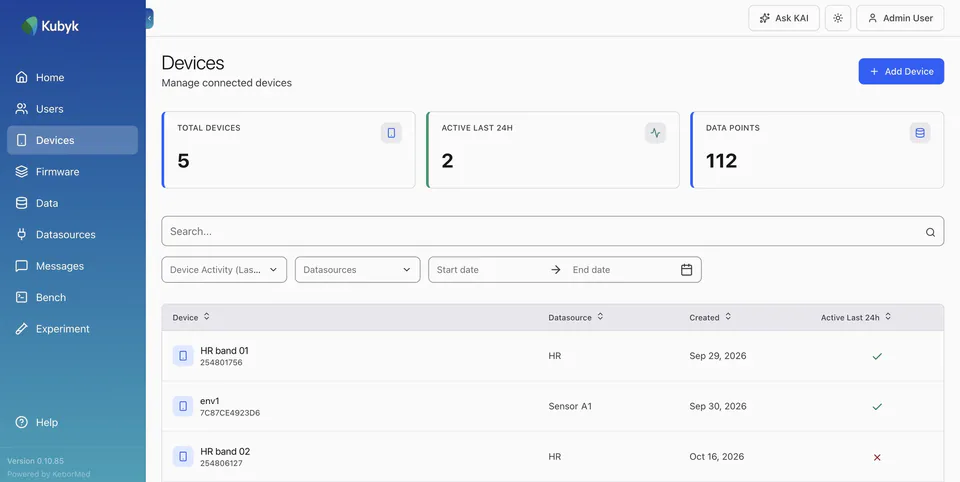
One site or several.
Each site in your study gets its own space, with its own admins, investigators and participants. Investigators see only the participants assigned to them.
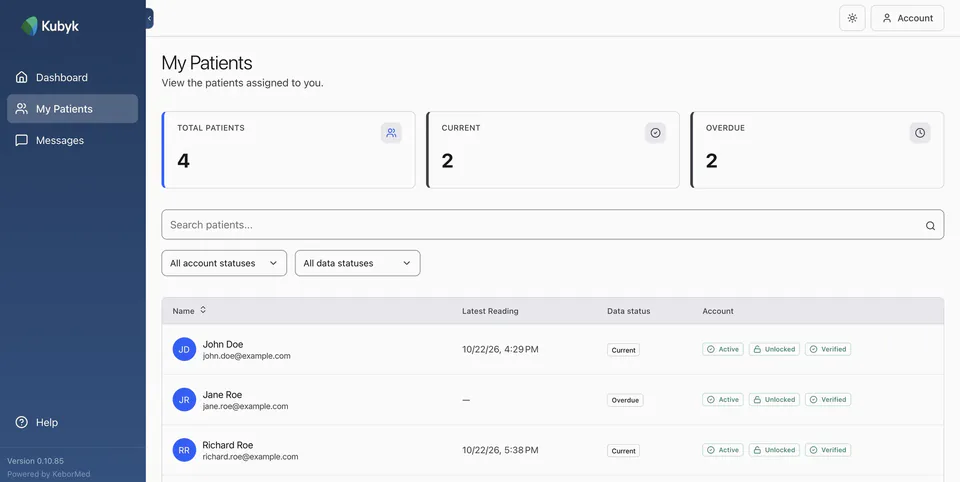
Know when data stops arriving.
Set how often each reading should come in. Investigators see the participants with missing data at the top of their list, and participants get a reminder too.
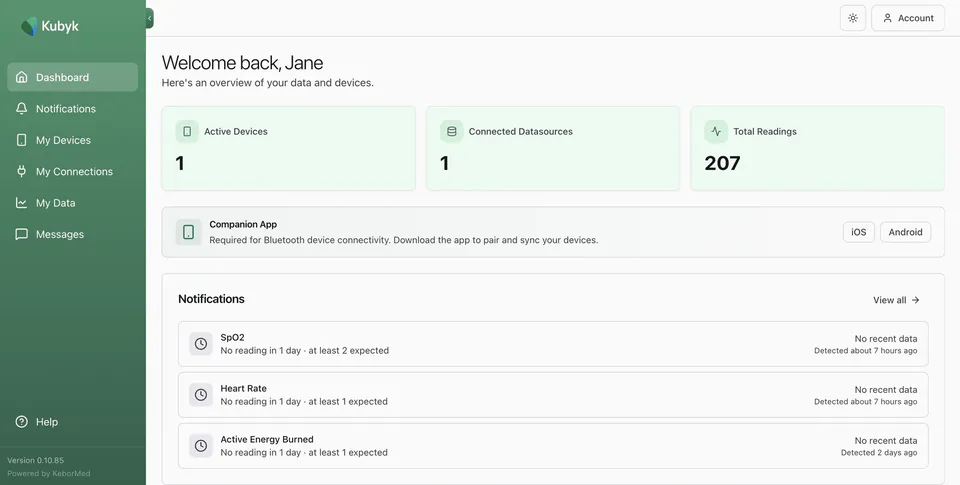
A full audit trail.
Every change is recorded with who made it, when, and what changed. An auditor role can review it when a study monitor or an inspector asks.
Available on Scale and every Kubyk Commercial tier, not on Lab or Lab+.
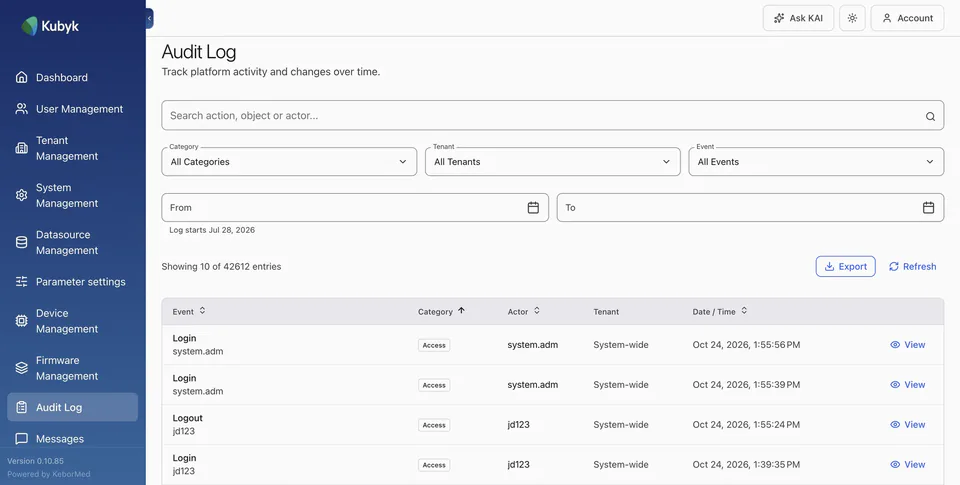
Run your own algorithm
Connect the code repository of your Python algorithm. Kubyk checks it for security issues, deploys it and feeds it your study data, logging every input and output. The algorithm stays yours.
A certified system when you need one
Enterprise Basic gives your program its own dedicated system, run under KeborMed's ISO 13485 and ISO 27001 certificates, and lets your FDA submission reference our FDA Master File.
In production since 2020
Connected medical devices have run on the platform since January 2020. Scale and Enterprise run on the same software.
Your Phase I data system: $18,000.Your Phase II data system: $60,000.Your Commercialization Readiness Pilot data system: from $234,000.Your Phase IIB data system: from $312,000.
Six months on Lab+ and six on Scale, 12 months in all. That is 5.6% of a $323,090 Phase I award.
24 months on Scale. That is 2.8% of a $2,153,927 Phase II award.
36 months on Enterprise Basic. The award cap depends on the NIH institute: $4,191,495 at eight institutes, $2,000,000 at seven and $500,000 at six. The pilot runs up to 3 years, and some institutes allow only 2.
48 months on Enterprise Basic, before clearance. The award cap depends on the institute: $3,000,000 at most participating institutes, $4,500,000 at NHLBI and NIAAA, and $15,000,000 at NCI, with a few held to the standard Phase II limit. Every NIH dollar needs at least one matching dollar.
| NIH award | NIH award amount | Kubyk plan | Kubyk cost | Kubyk cost as a share of the award |
|---|---|---|---|---|
| Phase I, 12 months | $323,090 | Lab+ 6 months, Scale 6 months | $18,000 | 5.6% |
| Phase I, 12 months | $323,090 | Lab+ only | $5,000 | 1.5% |
| Phase I waiver topic, 12 months | up to $700,000 | Lab+ 6 months, Scale 6 months | $18,000 | from 2.6% |
| Phase II, 24 months | $2,153,927 | Scale | $60,000 | 2.8% |
| Phase II waiver topic, 24 months | up to $3,000,000 | Scale | $60,000 | from 2.0% |
| Phase II, 24 months | $2,153,927 | Enterprise Basic | from $156,000 | 7.2% |
| Commercialization Readiness Pilot, 36 months, 8 institutes | $4,191,495 | Enterprise Basic | from $234,000 | 5.6% |
| Commercialization Readiness Pilot, 36 months, 7 institutes | $2,000,000 | Enterprise Basic | from $234,000 | 11.7% |
| Commercialization Readiness Pilot, 36 months, 6 institutes | $500,000 | Enterprise Basic | from $234,000 | 47% |
| Phase IIB, 48 months, before clearance, most institutes | $3,000,000 | Enterprise Basic | from $312,000 | 10.4% |
| Phase IIB, 48 months, before clearance, NCI | $15,000,000 | Enterprise Basic | from $312,000 | 2.1% |
| Phase IIB, 48 months, after clearance, most institutes | $3,000,000 | Enterprise Advanced | from $552,000 | 18.4% |
| Phase IIB, 48 months, after clearance, NCI | $15,000,000 | Enterprise Advanced | from $552,000 | 3.7% |
Kubyk costs assume Scale at $2,500 a month, Enterprise Basic from $6,500 a month and Enterprise Advanced from $11,500 a month, hosting included. Enterprise prices are for a yearly contract. NIH award amounts come from NIH funding announcements PA-27-100 (SBIR), PA-27-102 (STTR), PAR-27-098 and PA-27-101 and from NIH's small business program pages.
Waiver topics are research areas where NIH can fund above its standard limit. The cap depends on the institute, up to $3,000,000 for Phase II. SBIR and STTR follow the same NIH limits.
With matching funds, the whole project budget is at least twice the NIH award, so Kubyk's share of the whole project is at most half the figure shown.
Kubyk costs assume Lab+ at $500 a month or $5,000 a year, and Scale at $2,500 a month, hosting included. Waiver topics are research areas where NIH can fund above its standard limit; the cap depends on the institute, up to $700,000 for Phase I. SBIR and STTR follow the same NIH limits, from announcements PA-27-100 and PA-27-102. Ask your grants office how it treats a software subscription.
Two plans for Phase I.Two plans for Phase II.Enterprise Basic for the push to market.Enterprise Basic before FDA clearance, Advanced after.
Phase II studies run on Scale unless participants are already patients in a care relationship, or an FDA submission relies on the platform. Either one moves the study to Enterprise Basic.
Lab+
$500 a month, or $5,000 a yearBuild and test your whole system on synthetic data.
- Synthetic data only, no real participants
- Run your own Python code on incoming data
- Connect Bluetooth devices through the Kubyk phone app
- Becomes the test copy of your Scale system when you upgrade
Best for: Phase I development
Scale
$2,500 a monthStudies with real participants.
- Research under IRB oversight, at one US site or several
- Usability testing with your own staff
- HIPAA business associate agreement signed online when you upgrade
- Higher participant and device limits by agreement
Best for: Phase I studies and Phase II
Enterprise Basic
from $6,500 a monthYour own dedicated system, under a signed agreement.
- Run under KeborMed's ISO 13485 and ISO 27001 certificates
- KeborMed keeps the platform's regulatory documentation
- Your FDA submission can reference our FDA Master File
Best for: Phase II with patients in care, the Commercialization Readiness Pilot, Phase IIB before FDA clearance
Enterprise Advanced
from $11,500 a monthFor FDA-cleared devices in use with patients.
- Everything in Enterprise Basic
- Regulatory support after FDA clearance
- Each customer organization signs in through its own identity provider
Best for: the Commercialization Readiness Pilot or Phase IIB, after FDA clearance
Every price includes hosting. Enterprise prices are for a yearly contract.
Talk to us first if
- Any participant is already a patient in a care relationship, for example a patient of a partner clinic.
- Your device is already FDA-cleared, or the award includes selling the product.
Writing now?
Start free on Lab and build on simulated data while you write.
Start now. No new application needed.
NIH generally lets you move money between budget lines within an award if the project's scope stays the same. Check with your NIH grants management specialist first. Our free NIH application kit, which you can request at the end of this page, lists the Kubyk costs you will need for that request.
Ask about rebudgetingThe January 5, 2027 cycle
Next deadline: April 5, 2027. Check the requirements in your own funding announcement.
Next deadline: April 5, 2027. Requires an NIH SBIR or STTR Phase II or Phase IIB that is active or ended within the last 36 months. Check the requirements in your own funding announcement.
Next deadline: April 5, 2027. Requires an earlier NIH SBIR or STTR Phase II, with the application in within six due dates of its end, and new matching funds at least equal to the NIH funds requested, from private investors or from government funding other than an SBIR or STTR award. Check the requirements in your own funding announcement.
Questions Phase II teams ask.Questions Phase I teams ask.Questions Commercialization Readiness Pilot teams ask.Questions Phase IIB teams ask.
Can we put real data on Lab+?
No. Lab+ uses synthetic data only. Data from real participants goes on Scale.
Does Kubyk count against the Phase I limit on outside work?
On an SBIR Phase I, NIH normally expects your company to do two-thirds of the work, so consultants and contracts are generally limited to a third of the total budget. STTR rules differ: at least 40% by your company and 30% by your research partner. Ask your grants office whether a software subscription counts as outside work. If it does, $18,000 uses about a sixth of the SBIR allowance on a $323,090 award.
What happens at Phase II?
Your study can stay on Scale. If it needs Enterprise Basic, it moves to the same platform software, and we confirm what carries over before you budget it.
Can Scale run a multi-site study?
Yes, at sites in the United States.
What if we outgrow Scale's limits?
Scale has limits on participants and devices. We can raise them under a separate agreement.
When does a study need Enterprise Basic?
When any participant is already a patient in a care relationship, for example a patient of a partner clinic, or when your FDA submission relies on the platform.
Are the Enterprise plans certified?
They run on systems operated under KeborMed's ISO 13485 (medical device quality) and ISO 27001 (information security) certificates. Your device's FDA clearance and your own quality system remain your responsibility.
What does the FDA Master File reference give us?
An FDA Master File holds information about the platform that FDA can review directly. On the Enterprise plans, your submission can point to KeborMed's instead of including that information itself. It is already referenced in multiple cleared 510(k) devices.
Who owns our algorithm?
You do. Testing and validating it remains your responsibility.
We are applying for an STTR. Does Kubyk fit?
Yes. STTR uses the same phases, deadlines and NIH budget limits as SBIR. The difference is the work split: your company does at least 40% of the work and your research institution partner at least 30%, and the rest can go to either one or to outside services. On Scale, your research partner can have its own space in the same Kubyk system. Ask your grants office how the subscription counts toward the split.
Is a subscription an allowable cost?
Software subscriptions and cloud services usually go under Other Direct Costs in the NIH budget, on the ADP/Computer Services line. Your grants office and NIH decide, including how it counts toward outsourcing limits.
How does the Phase IIB match work?
NIH requires new third-party funds at least equal to the NIH funds requested over the whole project. They can come from new private investment, or from new government funding other than an SBIR or STTR Phase I or Phase II award. We state the Kubyk cost so your finance plan can show the split.
We started on Lab+ or Scale in Phase I. What carries over?
Lab+ becomes the test copy of your Scale system, and your study can stay on Scale. If it moves to Enterprise Basic, we confirm what carries over before you budget it.
Help with the rest of your application.
We are building a carefully vetted list of SBIR and STTR consulting partners to recommend to the teams we work with.
Are you an SBIR or STTR consultant?
Get listed here and recommended to applicants building on Kubyk.
Apply to be a partnerThe Kubyk NIH application kit.
A guide for teams that plan to include Kubyk in an NIH SBIR or STTR application. The kit is free and the same for every applicant. It covers:
- Where Kubyk belongs in the application: the budget and budget justification, Facilities and Other Resources, the Data Management and Sharing Plan and, from Phase II on, the Commercialization Plan
- Standard descriptions of the platform to adapt for those sections
- The Kubyk plan that fits each award, what moves a study from Scale to Enterprise, and the cost over the length of each award
- Key dates for the January 5, 2027 deadline
KeborMed does not give grant, legal or regulatory advice. NIH figures come from published NIH announcements; confirm current requirements in your own funding opportunity. Kubyk is a product of KeborMed Inc.
Talk to us
Tell us about your product.
A person on our team reads every message and replies by email.